
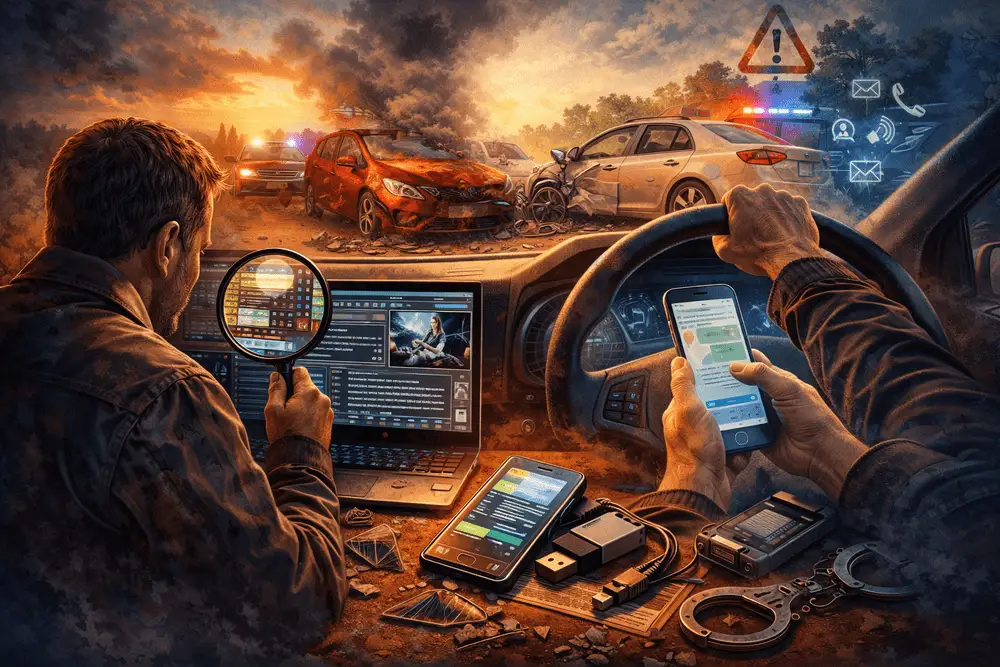
Distracted Driving: Leveraging Digital Forensics in Modern Investigations
Executive Summary
Distracted driving remains one of the leading causes of motor vehicle crashes across the United States. While law enforcement and accident reconstruction experts often identify the physical evidence of distraction, digital forensics provides a critical layer of investigative insight — enabling precise reconstruction of driver behavior and device activity before, during, and after a collision.
This white paper outlines how digital forensics can enhance distracted driving investigations, offering attorneys, insurance carriers, and accident investigators legally admissible evidence sourced directly from smartphones, vehicle systems, and cloud-connected platforms.
Understanding Distracted Driving
Distracted driving is broadly defined as any activity that diverts attention away from the act of driving. The most common forms include:
-
Texting or emailing
-
Social media use
-
Streaming or video calling
-
GPS input manipulation
-
Hands-on phone calls
-
Photo or video capture while driving
These actions often leave digital fingerprints, which can be recovered and analyzed through forensic processes.
The Role of Digital Forensics
Digital forensics enables investigators to extract and analyze a wide array of evidence from mobile devices, vehicle infotainment systems, and cloud services. The goal is to establish user interaction timelines that correlate with crash data, location information, and other sensor inputs.
📱 Mobile Device Analysis
-
Text messages, iMessages, SMS
-
App usage logs (e.g., Snapchat, Instagram, TikTok)
-
Touch event logs and screen interactions
-
Call logs and duration
-
Notifications received or dismissed during drive time
-
Battery logs, charging events, and accelerometer triggers
🚗 Vehicle System Analysis
-
Infotainment system logs (Android Auto / Apple CarPlay)
-
Bluetooth pair logs and call initiation
-
Navigation activity before or during incident
-
Event data recorder (EDR) timestamps
☁️ Cloud-Based Evidence
-
iCloud/Google account backup timestamps
-
Cloud photo uploads during drive time
-
Account synchronization logs
-
GPS and location history from Google Timeline or Apple Location Services
Case Applications
Digital forensics has been successfully applied in distracted driving cases to:
-
Refute or confirm a driver’s denial of mobile use
-
Identify third-party liability (e.g., company-issued phones or ride-share scenarios)
-
Establish user activity seconds before a fatal crash
-
Support civil claims or criminal charges (e.g., negligent homicide, wrongful death)
In one documented case, screen interaction logs confirmed the driver was scrolling through Instagram just seconds before a pedestrian was struck, contradicting their sworn statement.
Admissibility & Forensic Integrity
All data is collected using court-validated forensic tools (e.g., Cellebrite UFED, Magnet AXIOM) and follows strict chain-of-custody protocols to ensure admissibility. Forensic reports are prepared to meet civil and criminal court standards, with expert testimony available when required.
Conclusion
In an era where almost every driver possesses a smartphone, digital forensics plays a vital role in uncovering the truth behind distracted driving claims. Guardian Forensics specializes in recovering, analyzing, and testifying on digital evidence that may otherwise go undetected — helping legal teams, insurers, and law enforcement hold drivers accountable or defend the wrongly accused.
